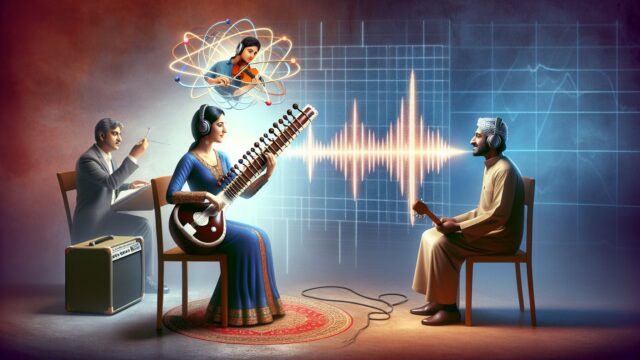
Welcome aboard Musicians! Have you ever wondered about the science behind your music getting played on radios? This article aims to shed some light on the magic of radio frequencies and how audio is transmitted, all while keeping it simple and insightful.
Introduction
From rocking out to your favorite band on the FM band, radio frequencies play an integral role in our daily lives. They allow the seamless transmission of waves for communication, entertainment and so much more. If you’re a musician, you might also be knowing how radio airplay matters enormously for your visibility and success. So, here’s diving into the realm of ‘how’ music travels through the airwaves, all the way, from the studio to our stereos.
Conception of Soundwaves
Let’s start from the ground up.
The music we adore starts as sound waves. A sound wave is a type of pressure wave caused when something vibrates, creating a wave which then travels through a medium, such as air, and reaches our ears. Our brains interpret these waves as different sounds, depending on their frequency and amplitude.
Now, the big question is, how does this sound convert into radio waves? This puzzle leads us to the process of modulation.
The Art of Modulation
In simple terms, modulation is a process where the properties of a carrier wave – regularly a high-frequency sine wave – are varied in accordance with an input signal which, in this case, is the audio from your music.
Amplitude Modulation
Historically, Amplitude Modulation, or AM, was the earliest modulation method used to transmit voice by radio. It works by varying the strength (or amplitude) of the carrier wave in proportion to the waveform being sent. This waveform may correspond to sounds from a conversation or to the intensities of the different instruments in your music track.
Frequency Modulation
Another type of modulation that is commonly used, and most likely involved in broadcasting your latest track on the radio, is Frequency Modulation (FM). In contrast to AM, FM works by varying the frequency of the carrier wave proportionally to the waveform being sent.
The Journey of the Signal in Radio Transmission
Your song, now encapsulated in modulated radio waves, is ready to travel!
Radio stations have massive antennas that they use to push your music out to the world. The modulated signal is amplified and sent out through the antenna into free space. The transmitted signal propagates outward in all directions and can be picked up by any radio set tuned into the right frequency.
Broadcasting and Netcasting
It’s interesting to understand how both physical and internet radios work helming on same principles.
While traditional stations have a physical broadcasting infrastructure, internet or web radios use netcasting. Netcasting utilizes packet switching to send audio and video over the internet. This approach enables streaming which is analogous to broadcasting your music in principle but over a different media. Quite fascinating, right?
The Listener’s End
Let’s look at what happens at the listener’s end.
Imagine someone sitting in their room, miles away, tuning into the station playing your song. Their radio receiver gets the signal and demodulates it to derive the original audio information (your music). This is then amplified and sent to the speaker, giving them the pleasure of hearing your latest composition.
Conclusion
In a nutshell, the journey your music takes from you to your listeners is a fascinating process intertwining physics, engineering, and music. It starts with your music as a sound wave, gets turned into an electrical signal, modulated onto a radio wave, transmitted, received and then finally, transformed back into sound for the eager ears of your listeners.
Radio frequencies and their role in transmitting audio is fundamental to how we connect, interact, and share our creativity. So, the next time you hear your song on the radio, you’ll appreciate not just the melody, but also the intricate dance of science that brought it to life.
Being a musician is not just about creating enchanting melodies and harmonious tunes, it’s also about appreciating the magic of radio wave transmission that carries your artistry to your fans. Keep creating, keep broadcasting!