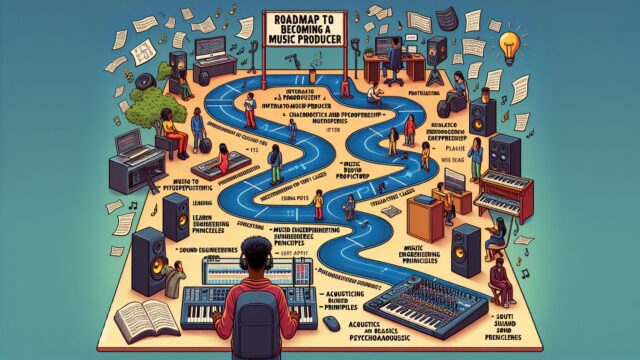
Success in the radio industry, specifically for music producers, entails agility, adaptability, and a well-rounded educational foundation. This includes an understanding of the fundamentals of music, business and communication augmented by the technology of broadcasting and podcasting.
This article will guide you in plotting a robust college curriculum that can act as stepping stones to a fulfilling radio career in the realm of music production. By focusing on key subjects and skills, you can shape your college experience to serve as a firm stepping stone to your desired career trajectory.
Music Theory
Understanding music is essential to the profession of music production. A solid foundation in music theory will provide you with the competency to identify and differentiate between genres, patterns, and styles that define music trends worldwide.
Courses in music theory help to hone personal taste and the ability to discern what makes a particular track resonate with an audience. This includes understanding elements such as rhythm, melody, harmony, structure and texture.
Communication Studies
Communication plays a pivotal role in the radio realm. Courses in this field will assist you in polishing the soft skills required to interact effectively with artists, executives, listeners, advertisers, and other relevant entities.
Courses in mass communication will enlighten you about the various models of communication, media effects, and audience response, while courses like public speaking can enhance your articulation, presentation, and persuasion skills. Knowledge of multiple languages can also be beneficial to communicate content effectively across different demographics.
Business and Marketing
Music is a dynamic, evolving industry and it operates in tandem with the business world. A grounding in business and marketing could become your north star in an erratic, ever-changing industry.
Courses in business administration, marketing, promotion, and advertising can help you maneuver the complex and competitive music industry effectively. Understanding how to advertise on radio stations, converge media platforms or how to handle PR crises are only a few of the many skills you can learn.
Broadcasting and Podcasting
Courses in broadcasting, recording, and podcasting technologies teach you how to channel a piece of music from the studio to the audience’s ears. They provide insight into the practical side of the radio industry, including station operation, programming, and audio production.
Considering the advent of the digital age, modern radios aren’t just about AM and FM anymore. The surge in podcasting has opened up new possibilities for music producers. Understanding this platform can help break away from the constraints of traditional radio formats to experiment with fresh content delivery methods.
Internships And Practical Exposure
All your theoretical knowledge would hold no value without its practical application. Therefore, internships or work-study programs at radio stations, recording studios, or with music producers should be a vital part of your academic timeline. Not only does it give a sneak peek inside the industry operations, but it also allows you to network with professionals, which could potentially open up job opportunities post-graduation.
Conclusion
Radio remains a powerful, influential medium in an era dominated by digital and social media. As such, the role of music producers is not just about selecting and arranging music but also about understanding evolving listener preferences, utilizing technology optimally, and navigating the business landscape shrewdly.
Therefore, when planning your college studies, focus on diverse but interrelated subjects to build a dynamic skill set. This broad-based education, coupled with practical industry exposure, can significantly increase your chances of breaking into, and more importantly, thriving in the music radio industry.